Olenivka: THE QUINTESSENCE OF CRUELTY
The exhibition was created by the Association of Families of Azovstal Defenders with the support of the National Memorial Complex of the Heavenly Hundred Heroes – Museum of the Revolution of Dignity. Among those who lost their lives were participants of the Revolution of Dignity.
2025

Surrendering into captivity.
Olenivka.
The defense of Mariupol in the spring of 2022 laster 86 days. 82 of which were under complete encirclement. To save the lives of the personnel, on May 16, 2022, the higher military-political commano of Ukraine ordered about 2,500 fighters of the Mariupol garrison, including around 1,000 soldiers from the 12th Special Forces Brigade Azov of the National Guard of Ukraine, to surrender from the Azovstal plant. They were all initially taken to the former Volnovakha correctional colony No. 120 in the temporarily occupied Olenivka in the Donetsk region.
Allocation
to barracks
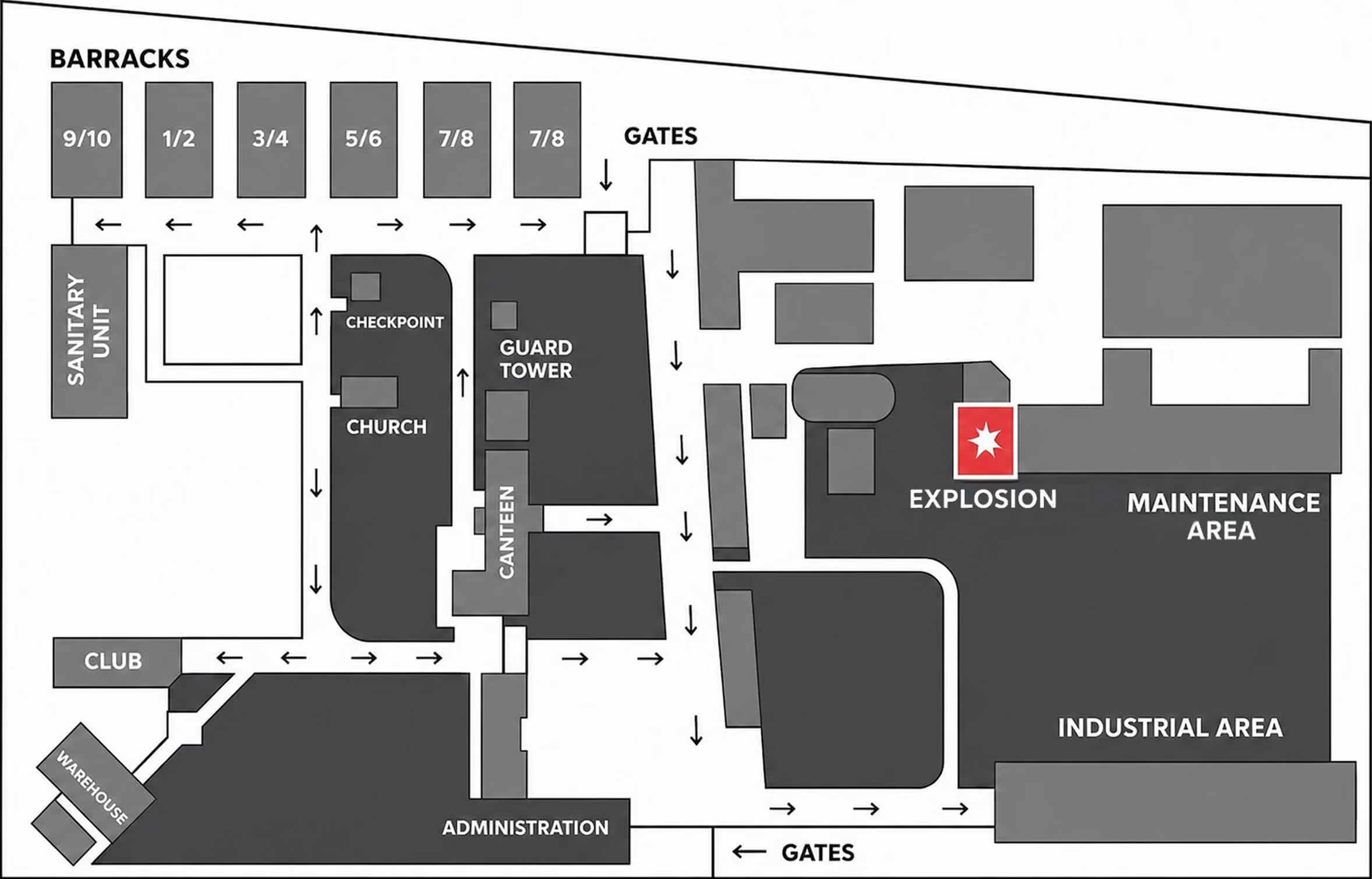
The Azov fighters were assigned two barracks: 9/10 and 1/2, located in the far left corner of the colony.
Inside, there were neither beds nor mattresses: they slept on the floor. Some were lucky and had sleeping mats. Some POWs slept outside the barracks due to lack of space.

Transfer
to barrack 200
In early July 2022, one of the premises in the industrial zone of the colony began to be converted. There was information that several hundred Azov fighters were to be transferred to a correctional colony in Horlivka.
The association families. On July 26, guards with lists appeared in the Azov fighters' barracks. The lists included representatives of various Azov units, both privates and officers. It is still unclear who selected them and what was the selection process, but only Azov fighters were listed, no members of other units were included. There were 198 people. Five were sent to the Donetsk pre-trial detention center on the same day, leaving 193.
Inside the newly created barrack, which was previously a metalworking workshop, there were bunk beds. Mattresses and pillows were provided later. The barrack was hastily prepared. A few days before the Azov fighters were transferred, barbed wire was added to the fence. Trenches were dug near the barrack by the guards.

Barrack 200
The association
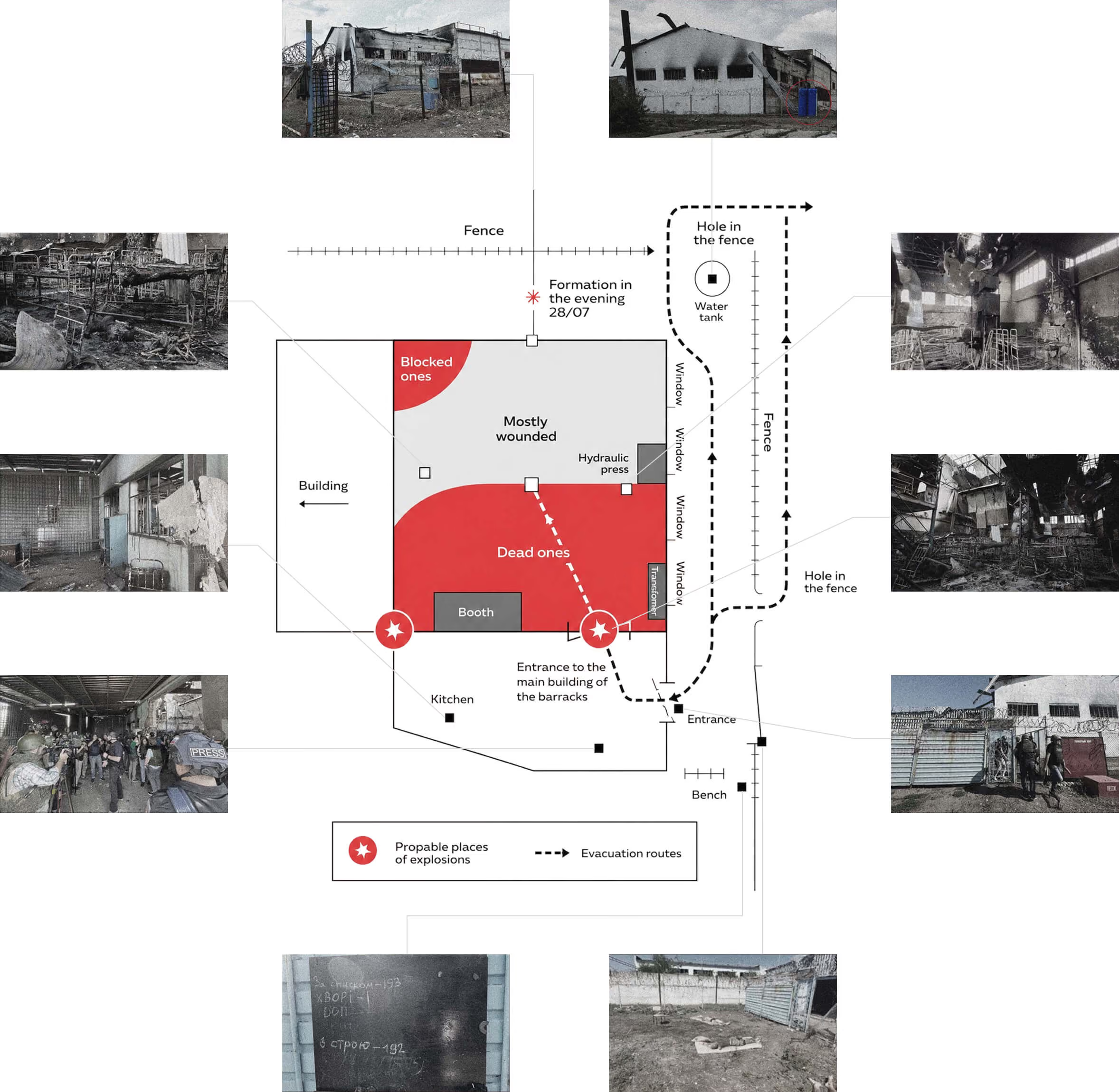
The barrack was divided into two parts. The first was at the entrance, a metal extension where an improvised kitchen was located. The second could be accessed through large heavy iron gates. Behind them was a workshop with concrete block walls. Above - a metal roof. There were presses and machines inside. The windows were high and did not open. On the very first day, the Azov fighters asked to remove the glass so that they could breathe easier, but it was not done.
The bunk beds were packed tightly throughout the barrack, making it extremely difficult to move between rows. To the left of the entrance, as is common in workshops, there was a two-room booth for the chief engineer, accessible by stairs.

Day 1. Organizing prisoner life
In the evening a general alignment was held. Names were called out to ensure everyone was present and taken inside. According to orders, no one was allowed to go outside, not even to the toilet, except one at a time if absolutely necessary.
A man with the call sign "Hunter" was present during these procedures. He was always there when prisoners were transported for interrogations, moved to another colony, or handed over for exchange.
Later, everyone was locked inside for the night. The Azov fighters initially planned to use the engineer's booth for sleeping but later decided to leave it as a meeting room. It was in this booth that prisoners gathered on the day of July 28 before the attack, discussing when to turn off the lights and go to sleep. Some wanted to do it at 10:00 PM, others at 11:00 PM, and they settled on 10:30 PM.
The Azov fighters note that the guards ordered everyone to leave the perimeter the night before, not allowing anyone to sleep outside.
Day 2. The night of the attack
At about 11:30 PM on July 28, the first explosion occurred. Something fell outside the colony's territory. Then a second explosion occurred. This time in the barrack, around 11:45 PM. Right after, a third explosion took place.
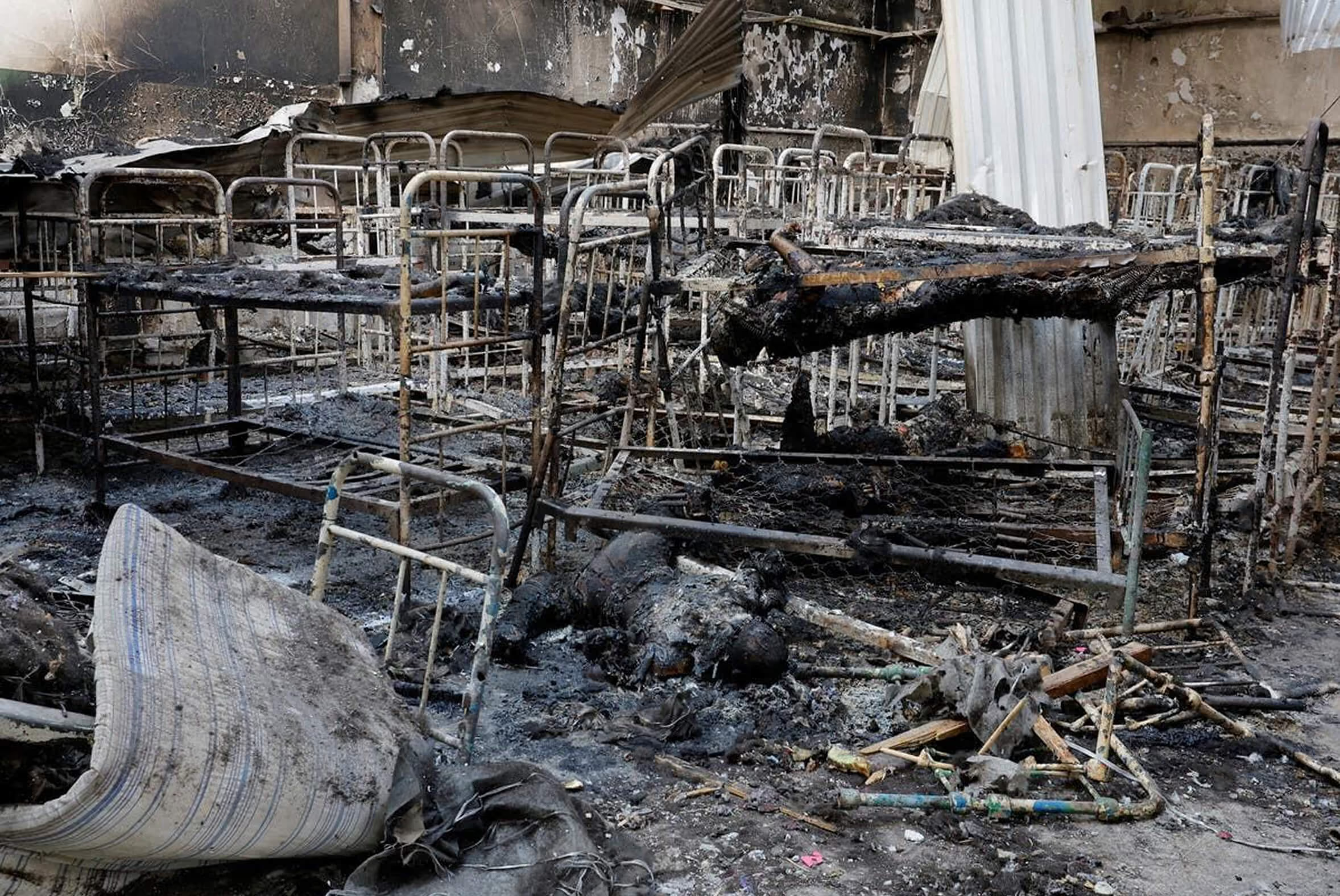
According to the Azov fighters, there was one exit from the barrack through the gates blown off by the explosion and a door nearby, but also, a hole had formed in the wall in the left corner of the barrack. The fighters saw that a fire had started. Those who could, returned to the barrack to pull out their brothers-in-arms, even the dead ones. Returned to at least save the bodies.
After this, the Azov fighters broke through the fence, which they had figured out during the inspection of the barrack could be easily done. Those who could, ran; those who couldn't, crawled towards the colony's administration building. Inside the barrack, everything was on fire. There were screams, but due to the fire, entering the barrack was impossible. The colony's administration did nothing to extinguish the fire or provide medical aid to the wounded, who died from burns and blood loss. A person with an automatic rifle appeared from somewhere and started shooting.
Day 3. They didn't let us help our brothers-in-arms
For six hours after the explosions, the wounded Azov fighters received no medical assistance. Most had shrapnel injuries, with parts of the roof and beds embedded in their bodies. Springs and pieces of insulation were later extracted from their bodies. Many Azov fighters suffered burns.
The colony's staff did not even try to save the wounded. Ambulances stood behind the gates, arriving 30 minutes after the explosion. The Azov fighters handed over a wounded fighter in a sleeping bag, pulling him under the fence, but after a while, these "doctors" returned him, though he was still alive, saying there was no hope. When asked, "Should we send more?" the response was, "No". The fighters then asked for a needle to decompress those with chest injuries but were refused. Instead, rags, water, some Esmarch bandages, something resembling tourniquets, and Soviet-style dressing packages were thrown over the fence.
Approx.
between 2:00 and 3:00 AM
Between 2:00 and 3:00 AM on July 29, other imprisoned medics were brought to the alley along the outer wall of the colony. By that time, everyone was used to explosions in Olenivka, as the front line was nearby, and they were constantly heard. But these were different. Prisoners from other barracks ran outside, seeing smoke rising over the industrial zone and hearing terrible screams, even though it was quite far. They gathered everything they had: a few tourniquets, bandages, and painkillers. But they couldn't run there: they had to wait for someone to come for them.
The alley was completely covered in blood. Some had traumatic amputations, deep abdominal wounds, head injuries, and numerous shrapnel wounds. People were dying in their hands. Medics said some victims had no visible injuries but had weak pulses and low blood pressure, indicating severe internal injuries. Without proper equipment and medications, medics could not help them. They did what they could: stopped bleeding, applied tourniquets, and bandaged wounds. As prisoner medics provided help, some guards threw rags over the fence. They threw a lot of pre-torn rags.

The colony's leadership stood indifferently behind the fence, unconcerned about possible repeated hits. The wounded were sorted for evacuation, with the most critical placed closest to the fence, those in moderate condition in the middle, and the lightly injured at the end of the alley. Medics were ready to hand people over for evacuation, but the colony's administration did not hurry. They started printing lists and photos, matching everyone. While doing this, five Azov fighters died from blood loss.
Each person was identified by photos taken upon their arrival at the colony. First, they waited for the photos to be brought, then went around and checked each person's face. Everything had to match: appearance, surname, tattoos, and call sign. Due to the pain shock some faces were distorted, and it was dark, so identification took time. Guards realized they hadn't printed all the photos and ran off to print more.
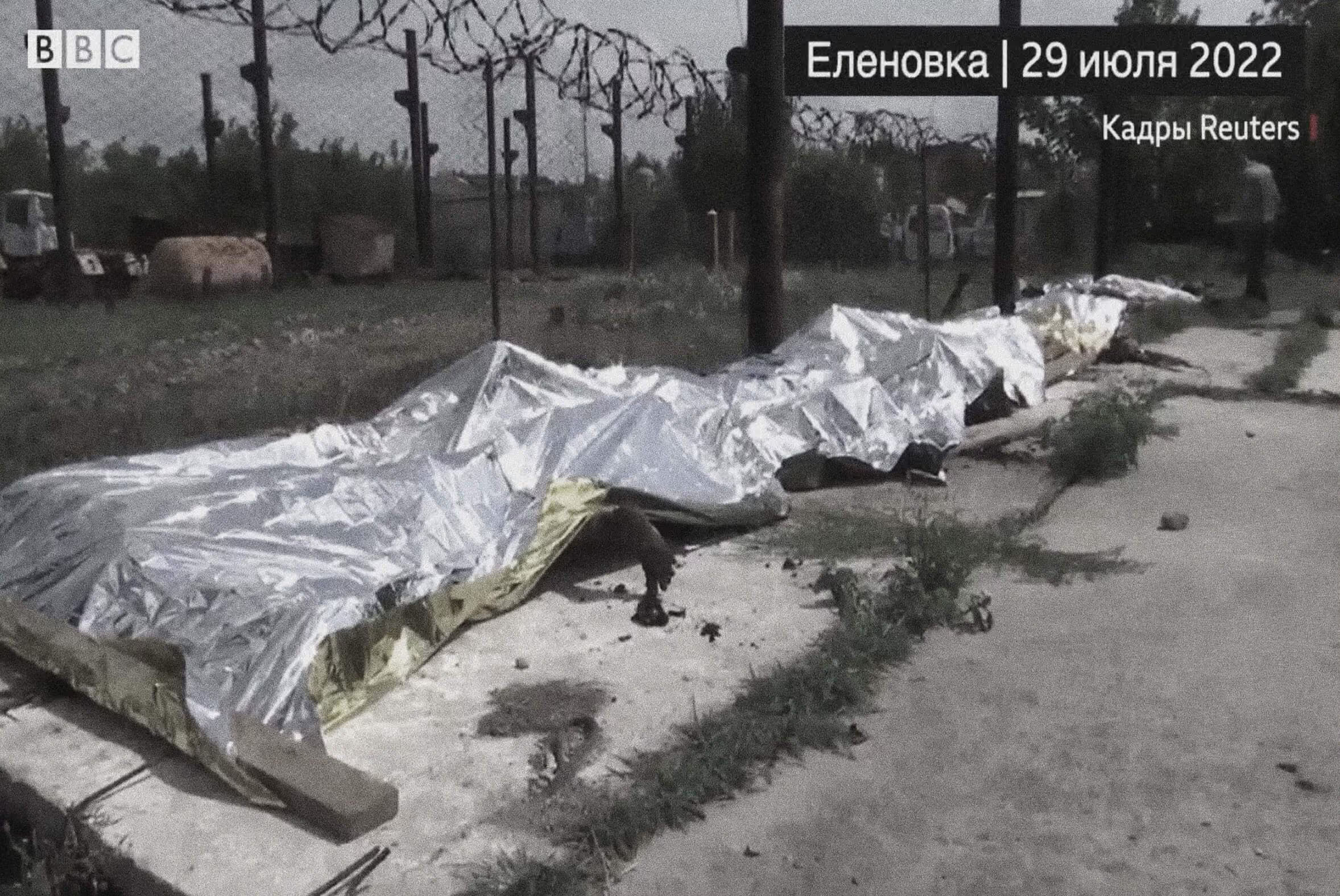
The evacuation finally took place at 5:00 AM. Kamaz trucks entered the territory, and the severely wounded were transported to Donetsk hospital No. 14, not in ambulances, but in trucks. As a result of the attack, 54 fighters died, and about 130 were injured.
A prisoner of war
who collected the remains
of bodies.
One of the prisoners from barrack 9/10 said they heard explosions, but the guards ordered everyone to stay quiet, threatening to shoot for disobedience. In the morning the guards came: "Well, are you ready to collect arms and legs?"
Bohdan was taken to the industrial zone. The first bodies he saw were under the fence near the administration building. There, he was given a marker to identify the bodies. The first he identified were fighters with the call signs "Shid", "Lamour", "Jones", and "More". Then he was taken to the barrack where the explosions occurred. According to Bohdan, three so-called "investigators" were working there. He said they were DR members, but photos found by Media Initiative for Human Rights showed representatives of the Russian Investigative Committee, possibly joining later.
All the beds were piled up. They were moved to extract the bodies. The dead were carried to a small corridor where I had to identify them. However, many were almost impossible to identify. — Bohdan recalls. Entering the barrack, Bohdan saw that one of the explosions occurred near the entrance door: "It just blew them out, ripping one part out with a piece of the wall".

The second explosion, he confirms, occurred behind the engineer's booth, completely breaking through the roof and part of the wall. However, neither the video nor other photos published by Russia show this part of the barrack, although numerous representatives of Russian propaganda media arrived to film the aftermath. In one video, when the camera panned to the left of the entrance, a voice behind the camera asked: "Not to film this?"
Fragments appeared in the barrack later, brought in just before the journalists arrived. Bohdan saw with his own eyes how the guards took shrapnel fragments out of bags.
Russian lists
of the wounded
and dead
On July 29, lists of the dead were published on Russian Telegram channels. Relatives and friends of the prisoners began searching through the lists, praying not to find a familiar name. Unfortunately, for 48 families, that day brought the worst news. Most of the bodies remained on the territory of the Olenivka colony. Burnt bodies were taken outside and covered, lying in the open for some time. Later, they were stored improperly.
Russian lies and theories
about the tragedy's causes
Russia immediately put forth its own version: that the Ukrainian side shelled Olenivka using American HIMARS rocket artillery systems. They claimed that the Azov fighters, isolated in the barrack, had become inconvenient for the Ukrainian authorities because they started giving testimony "about the crimes of the Kyiv regime". The Russians displayed alleged HIMARS fragments lying on a bench.
However, Ukrainian and international experts refuted this version. In August 2022, experts interviewed by CNN noted that Russia was likely lying about the use of HIMARS. Firstly, there should have been traces on the ground, which were not visible in the photos. Secondly, it would not be practical to use HIMARS at such a short distance — the colony was only 15 kilometers from the front line, and HIMARS is a long-range weapon. Instead, it was clear from the photos that a fire had broken out due to the explosions, evidenced by the burnt bodies.
For that reason, in the first hours after the explosion, experts initially suggested that thermobaric weapons were used in Olenivka. Such weapons are typically used to destroy fortifications during urban combat, burning everything inside the buildings within 10-15 seconds at extremely high temperatures of up to 2500°C, with the highest temperature at the epicenter, and lower further out. In August 2022, Ukraine's Prosecutor General Andriy Kostin stated that the colony's premises were destroyed not by missiles but by thermobaric weapons.


The Defense Intelligence of Ukraine (GUR) reported that the attack was carried out by PMC "Wagner" (now called PM "League"), acting on orders from Yevgeny Prigozhin.
However, these killings were not coordinated with the Russian Ministry of Defense. From the beginning, the Russians had no intention of exchanging Ukrainian prisoners of war but instead subjected them to torture. The torture involved militants from the terrorist group "DNR", mercenaries from the PM "Wagner", and the FSB. The explosion in Olenivka on July 29 was thus a way to cover up the improper conditions and criminal forms of interrogation.
The Security Service of Ukraine (SBU) released an intercepted conversation of DR militants indicating that the Russians placed BM-21 "Grad" rocket launchers near the colony, from where they fired at Ukrainian positions but received no return fire. Moreover, the militants suggested that the explosion in the barrack could have been staged from inside the building, as evidenced by the nature of the destruction. None of the eyewitnesses heard a rocket approaching the colony. There was no signifying whistling sound and the explosions happened on their own.
Available videos show that windows in separate parts of the colony were completely intact, confirming that the epicenter of the explosion was inside the destroyed building and its walls "absorbed" the blast waves, protecting the neighboring premises. Preliminary video analysis also suggested that the traces of the explosion on the walls were most likely caused by an "internal source" of the explosion.
On July 31, 2022, the Maxar aerospace company published satellite images of the prison taken on July 27 (before the explosion) and July 30 (after the explosion). The images showed that only one building, where Ukrainian prisoners were held, was damaged by the explosion, while all other buildings were intact and showed no visible damage.
Italian military expert Thomas Theiner concluded that "it is likely the Russians locked the doors, shot inside through the windows with thermobaric munitions RPO-A 'Shmel' or MRO-A, and then waited for everyone to die". Both weapons have been in use with the DNR since 2014.
Returning the bodies
On October 11, 2022, Ukraine returned the bodies of 62 fallen defenders, including those killed in Olenivka. As of 2024, international examinations are still ongoing and the identification of bodies in some cases is almost impossible due to the significant degree of damage, worsened by improper storage conditions in the first months after the attack.

Investigation without
access to the crime
scene
In response to the Media Initiative for Human Rights' inquiry, the Office of the Prosecutor General stated that the preliminary legal qualification is Part 2 of Article 438 of the Criminal Code of Ukraine (violation of the laws and customs of war). During the pre-trial investigation, investigators interviewed 47 people, including 13 servicemen who were in the barrack. The biggest challenge, according to the Prosecutor General's Office, is that "the investigation does not have access to the site of the attack and lacks any reliable and objective data from international independent organizations due to their non-admission by the aggressor state".
The UN mission
On August 3, 2022, UN Secretary-General António Guterres announced the creation of a UN mission to gather facts about the deaths of Ukrainian prisoners of war in Olenivka. Brazilian General Carlos dos Santos Cruz was appointed head of the mission. On September 8, the head of the UN Human Rights Mission in Ukraine, Matilda Bogner, reported that Russia denied UN observers access to the attack site.
On January 5, 2023, UN Secretary-General spokesperson Stéphane Dujarric announced that Guterres had decided to disband the mission due to the lack of conditions necessary for its deployment on-site. In July 2024, the Association of Families of Defenders of Azovstal sent a letter to the UN urging the resumption of the mission.
Public outcry
and rallies
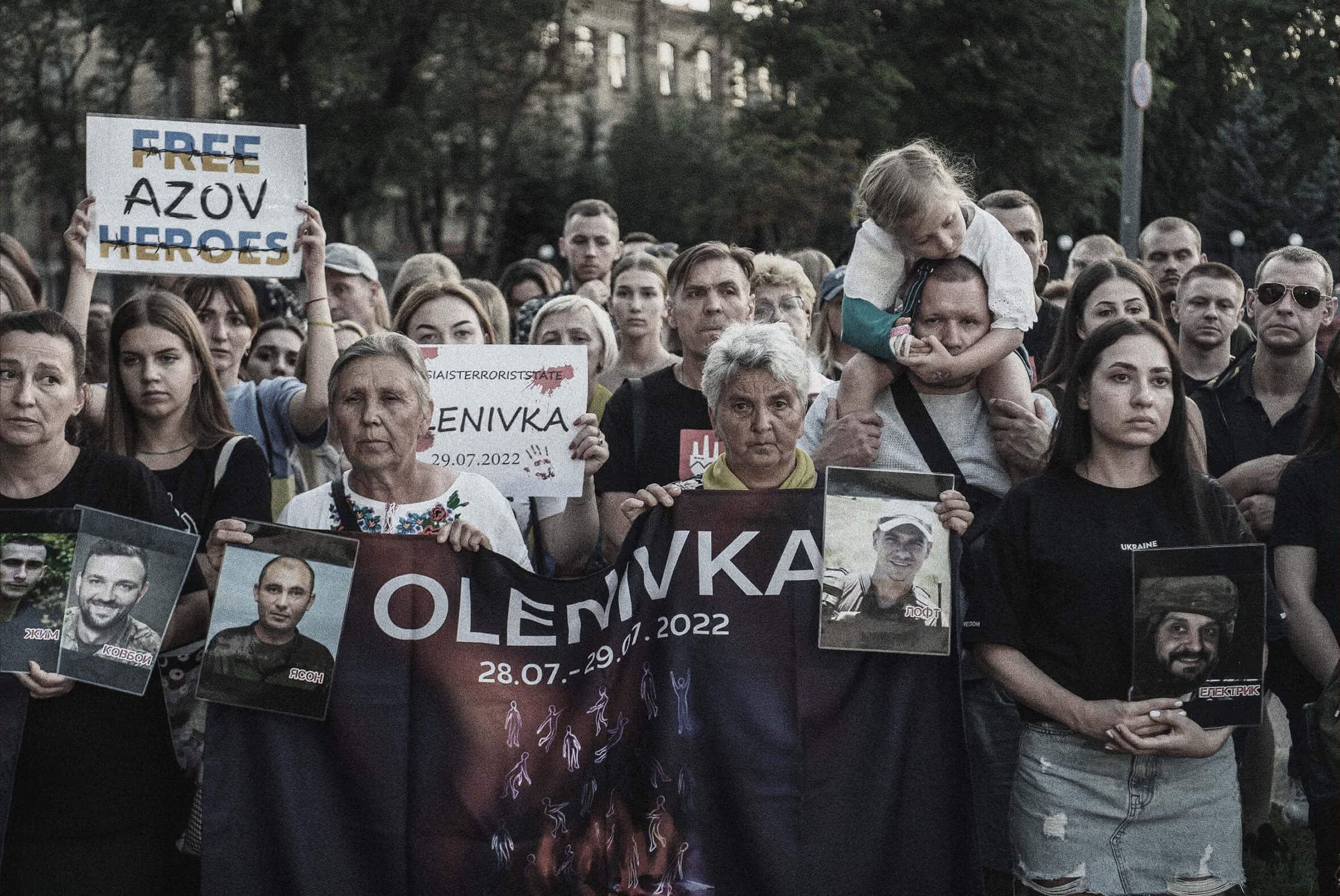
On July 30, 2022, the families of prisoners of war gathered at St Sophia Square in Kyiv, calling on the international community to recognize Russia as a state sponsor of terrorism and to seek the exchange of POWs. They emphasized that when the defenders of Azovstal laid down their arms and surrendered under orders, the UN and the International Committee of the Red Cross assured that their lives would be protected.
By the first year commemoration of the attack, a petition (No. 22/198728-e) was created to establish national days of mourning and remembrance for the defenders executed in Olenivka. The petition gathered the necessary number of signatures but unfortunately received no response from the Ukrainian authorities.